
What inspired you to build an MCP plugin for Ant Media Server?
I was thinking a lot about what to build for the hackathon. I expected other participants to work on object detection problems, extract information from the video itself, and do something with it.
I wanted to do something special, and recently I had been reading a lot about the MCP protocol. I saw that more and more services and applications were advertising their MCP capabilities. I quickly checked whether any other media servers supported MCP, and I realized this was a new area.
I got a few ideas very quickly about how to demonstrate the MCP plugin, which made me very enthusiastic.
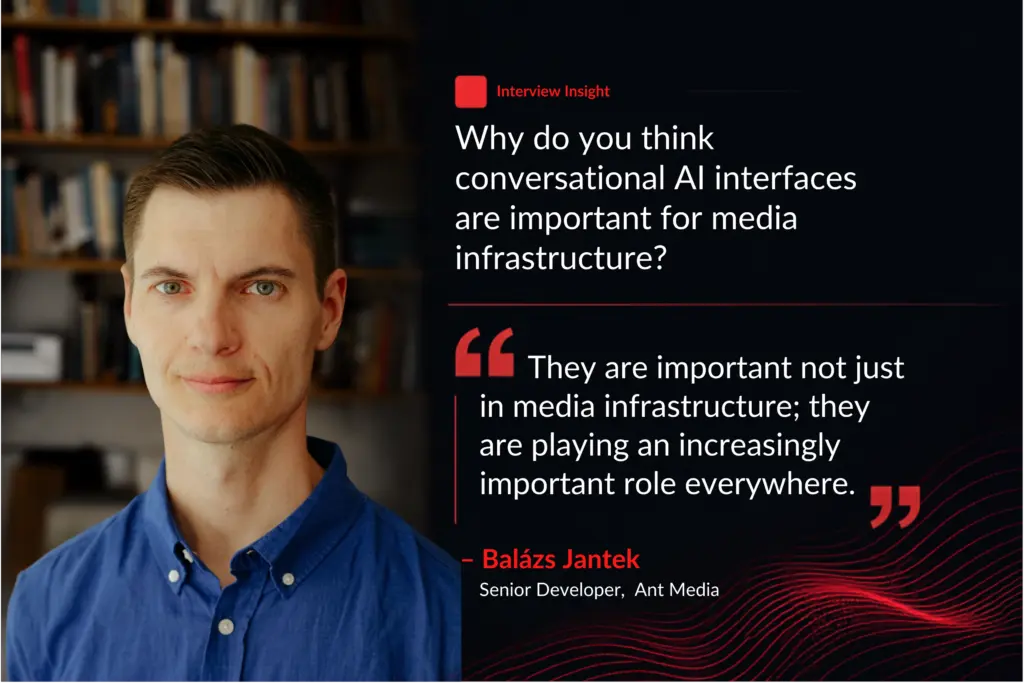
Why do you think conversational AI interfaces are important for media infrastructure?
They are important not just in media infrastructure; they are playing an increasingly important role everywhere.
What was the most technically challenging part of integrating MCP with Ant Media Server?
Ant Media Server uses a library called Jersey internally, which did not have MCP extensions. This required me to go to the root of the problem and implement the entire MCP stack myself on top of Jersey, which was challenging.
In the spirit of the “AI hackathon,” I did some vibe coding, and it was an interesting experience. These tools are evolving fast, but they still tend to get very detailed and precise specifications completely wrong. In the end, I had to go back and fix the code myself.
How do you see AI-powered server interaction evolving in the future?
At the time of the hackathon, the usage of MCPs from voice-driven agents was limited. That limitation will disappear relatively soon, freeing operators’ hands in the studio.
What real-world use cases do you think this plugin can unlock?
The ones that I highlighted in my demonstration: stream setup, starting and stopping recordings, and finding the root cause of typical problems from the server logs. I think these are the most important use cases.