
Getting into live streaming requires the right encoder software from day one. Two platforms dominate the encoder market for independent streamers and professional broadcasters alike: Streamlabs and OBS Studio. Both handle scene composition, audio mixing, and RTMP publish to media servers — but they differ on CPU overhead, setup complexity, plugin availability, and built-in feature sets.
This guide breaks down exactly what each platform does, where each performs better, and which hardware profiles and streaming goals each serves. By the end, the decision between Streamlabs vs. OBS reduces to 3 measurable variables rather than personal preference.
Table of Contents
What Does Streaming Software Actually Do?
Streaming software captures video and audio sources, composites them into a single output signal, and encodes that signal for delivery to a media server or platform. The core capability is video mixing, which lets broadcasters control:
- Camera switching between multiple input sources
- Pre-recorded video playback within a live broadcast
- Audio source selection and mixing
- Image and graphic overlay insertion
- Screen capture and desktop sharing
- Green screen keying and visual effects
Both OBS Studio and Streamlabs handle all 6 of these functions. The difference lies in how much system resources each consumes, how much configuration each requires, and what additional features each bundles into the package.
OBS Studio
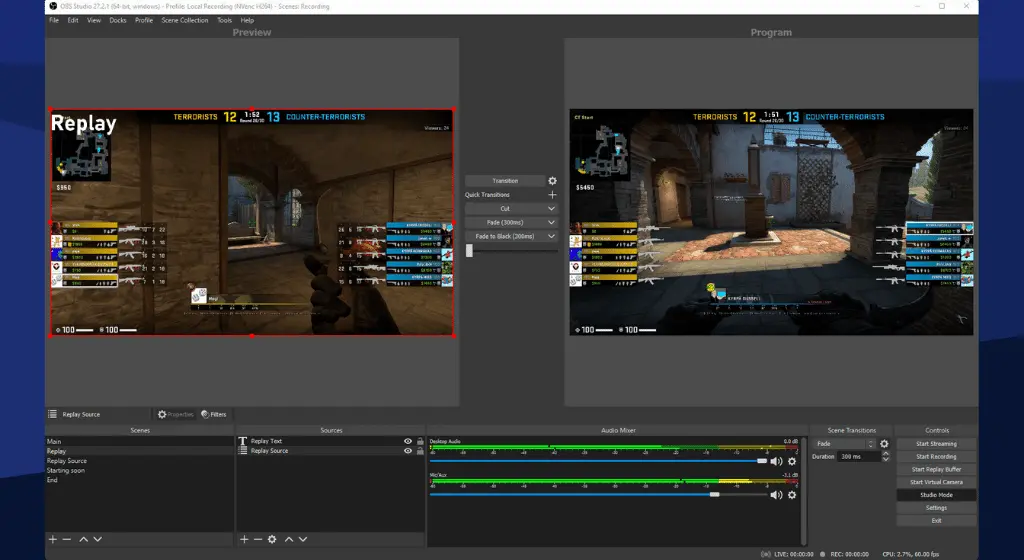
OBS stands for Open Broadcaster Software. It is the reference-standard encoder for independent streamers and one of the oldest active broadcasting platforms. The majority of streaming software developed after OBS — including Streamlabs — is built directly on its foundation.
Benefits of OBS Studio
Free with no subscription tier. OBS carries zero cost. Streamers building their first setup avoid any software outlay, which matters when camera and capture card costs already add up.
Open-source plugin architecture. Because OBS publishes its source code publicly, the developer community has built an extensive plugin library. Bug fixes reach users faster than with closed platforms because any developer can submit a patch.
Low CPU utilization. OBS consumes less processing headroom than Streamlabs under equivalent scene configurations. On mid-range hardware, the difference in encoding quality is measurable: lower CPU load leaves more cycles for the game or application being captured.
Customizable interface layout. OBS allows full panel rearrangement and workspace customization. New streamers find the default layout logical. Experienced broadcasters restructure it to match their specific production workflow.
Drawbacks of OBS Studio
No native audio file source support. OBS does not natively link to audio files as stream sources. Broadcasters who want music playback during streams need to route audio through a virtual audio device or secondary application.
Smaller plugin catalog than some alternatives. While OBS has plugins, some niche integrations available on competing platforms require manual workarounds under OBS.
Streamlabs
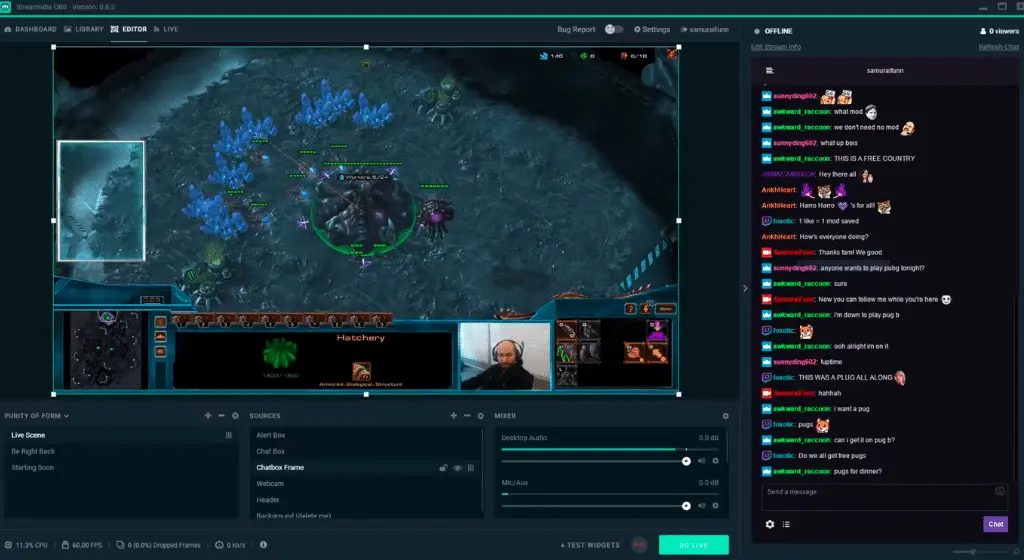
Streamlabs is a commercial streaming platform built on OBS’s open-source codebase and developed by Logitech. It layers additional features and a redesigned interface on top of OBS’s core encoding engine, targeting streamers who prioritize fast setup over maximum configurability.
Benefits of Streamlabs
Minimal-friction setup process. The Streamlabs setup sequence runs in 5 steps: download the installer, run it, connect a streaming account, run the automatic optimizer, and add a stream key. No manual encoder configuration is required to go live for the first time.
Pre-broadcast test mode. A dedicated test button lets streamers preview scene changes in a simulated broadcast state before going live. This catches configuration errors before they reach an audience.
Integrated chat management. Streamlabs embeds chat handling directly in the interface. Streamers monitor and interact with viewers without switching between application windows.
Drawbacks of Streamlabs
Higher CPU consumption. Streamlabs draws more processing resources than OBS under the same output settings. Streaming on hardware below the recommended spec introduces frame drop risk that OBS handles more gracefully on identical hardware.
Chat audio commands require a separate chatbot. Sound alerts triggered by chat events — follower notifications, donations, subscriptions — require running Streamlabs Chatbot as a separate process rather than handling everything through the primary interface.
Streamlabs vs. OBS: Direct Comparison

The choice between the two platforms reduces to 3 primary variables: hardware capacity, technical configuration tolerance, and feature requirements.
Choose OBS Studio if your CPU is running at or near capacity during gaming or application use, if you prefer open-source software, or if you plan to build a custom plugin-extended workflow over time.
Choose Streamlabs if fast setup matters more than resource efficiency, if integrated chat management reduces friction in your workflow, or if your hardware exceeds the encoding requirements with headroom to spare.
Neither platform is objectively superior. Both produce equivalent output quality at matching encoder settings. The performance difference appears under load, and the setup difference appears on first use.
Frequently Asked Questions
Is OBS Studio completely free?
OBS Studio is free with no subscription tier, no feature paywalls, and no trial period. The full encoding and scene composition feature set is available at zero cost under the GNU General Public License.
Does Streamlabs cost money?
Streamlabs offers a free tier with core encoding features. A paid Streamlabs Ultra subscription unlocks additional overlays, multistream destinations, and premium themes. The free version is sufficient for basic live streaming to a single destination.
Which uses less CPU — Streamlabs or OBS?
OBS Studio uses less CPU than Streamlabs under equivalent scene configurations. The gap is most pronounced on mid-range hardware: a system running at 70–80% CPU load during gameplay produces fewer dropped frames under OBS than under Streamlabs at identical output settings.
Can OBS stream to custom RTMP servers?
OBS Studio streams to any RTMP endpoint by entering a server URL and stream key in the output settings. This includes self-hosted media servers, private streaming infrastructure, and any platform that accepts RTMP ingest — not just Twitch, YouTube, or Facebook.
Which is better for beginners — Streamlabs or OBS?
Streamlabs reduces initial setup friction through its 5-step installer and automatic optimizer. OBS requires manual configuration of encoder settings, scenes, and sources but offers more control once configured. Beginners prioritizing speed of first broadcast choose Streamlabs; beginners willing to invest setup time for long-term flexibility choose OBS.
What streaming protocols do OBS and Streamlabs support?
Both platforms publish via RTMP as the primary protocol, which connects to any media server accepting RTMP ingest. OBS additionally supports SRT output through its custom FFMPEG encoder option, enabling lower-latency delivery over unreliable networks. Neither platform outputs HLS or WebRTC natively — those protocols are handled at the media server layer after ingest.
Understanding the Protocol Layer Beneath Your Encoder
Streamers who advance beyond basic video mixing typically evaluate protocol-level decisions next. RTMP publish workflows, HLS delivery latency, and WebRTC real-time transport each carry different trade-offs for audience reach and stream delay. Understanding RTMP streaming protocol mechanics — including how RTMP handles multiplexed audio-video chunks over TCP and why its lack of native browser support drives encoder-to-server workflows — clarifies why OBS Studio and Streamlabs both default to RTMP as their primary publish path.
OBS’s open-source architecture directly influenced the media server ecosystem it publishes to. Broadcasters running OBS against a self-hosted server benefit from reviewing WebRTC signaling server configuration — including ICE candidate exchange, STUN/TURN address resolution, and WebSocket handshake sequencing — to evaluate whether real-time sub-500ms delivery fits their viewer distribution requirements beyond what RTMP alone supports.
Next Steps: Configuring OBS Studio for a Media Server
Both platforms connect to media servers through RTMP stream keys. The OBS Studio streaming setup guide covers source configuration, scene management, and stream key setup for both Streamlabs OBS and standalone OBS Studio against custom media server destinations — providing a concrete workflow reference for the transition from default platform streaming to self-hosted infrastructure.
For Developers Building Streaming Platforms
Development teams building streaming applications face a different decision layer than streamers choosing encoder software. Evaluating encoder behavior at the protocol level — specifically how RTMP ingest handles dropped frames, keyframe intervals, and reconnection logic — informs media server selection. The adaptive bitrate streaming overview covers how servers receive fixed-bitrate RTMP input from tools like OBS and transcode it into multi-resolution HLS or DASH output for heterogeneous viewer connections.
Conclusion
Streamlabs and OBS Studio solve the same encoding problem through different trade-offs. OBS delivers lower CPU overhead, full open-source extensibility, and precise manual control over every encoder parameter — at the cost of a longer initial setup. Streamlabs delivers a 5-step guided configuration, integrated alert and chat management, and a pre-broadcast test mode — at the cost of higher resource consumption and a closed plugin ecosystem.
The decision narrows to hardware and intent. Streamers on mid-range CPUs who run demanding games alongside their broadcast get measurably better frame stability from OBS. Streamers prioritizing time-to-live and built-in audience interaction tools get a faster start with Streamlabs. Both platforms publish via RTMP to any media server — so the encoder choice does not lock in a delivery infrastructure decision.
The next variable after encoder selection is the media server receiving the RTMP stream. That layer determines delivery protocol, output latency, transcoding behavior, and viewer scale — none of which the encoder controls.
Validate Encoder-to-Server Behavior in a Test Environment
Streaming engineers validating server-side behavior against OBS and Streamlabs RTMP output — including keyframe alignment, audio codec passthrough fidelity, and reconnection handling across dropped publish connections — benefit from hands-on RTMP ingest testing providing full media server access for measuring encoder-to-server latency, transcoding pipeline behavior, and multi-protocol delivery configuration without infrastructure procurement.