

Content Delivery Networks (CDNs) are a foundational component of today’s digital infrastructure, especially for websites and platforms that serve global audiences. From loading web pages and streaming videos to delivering online services at scale, CDNs play a critical role in ensuring content reaches users quickly and reliably.
In modern video streaming and broadcasting, CDNs are no longer optional. They help reduce latency, improve performance, and handle traffic spikes by distributing content across geographically dispersed servers. Whether users realize it or not, CDNs are involved every time they watch a video, visit a high-traffic website, or interact with online applications.
This article explains what a CDN is, how it works, the different types of CDN architectures, and how CDNs support video streaming and live broadcasts. It also covers key considerations for choosing a CDN provider and understanding latency in modern streaming workflows.
What is a CDN (Content Delivery Network)?
A Content Delivery Network (CDN) is a distributed network of servers designed to deliver web content, videos, and applications to users with high performance and reliability. Instead of serving content from a single origin server, a CDN stores cached copies of content on multiple geographically distributed edge servers.
When a user requests content, the CDN delivers it from the closest available server, reducing the distance data needs to travel. This significantly improves load times, reduces latency, and minimizes strain on the origin infrastructure.
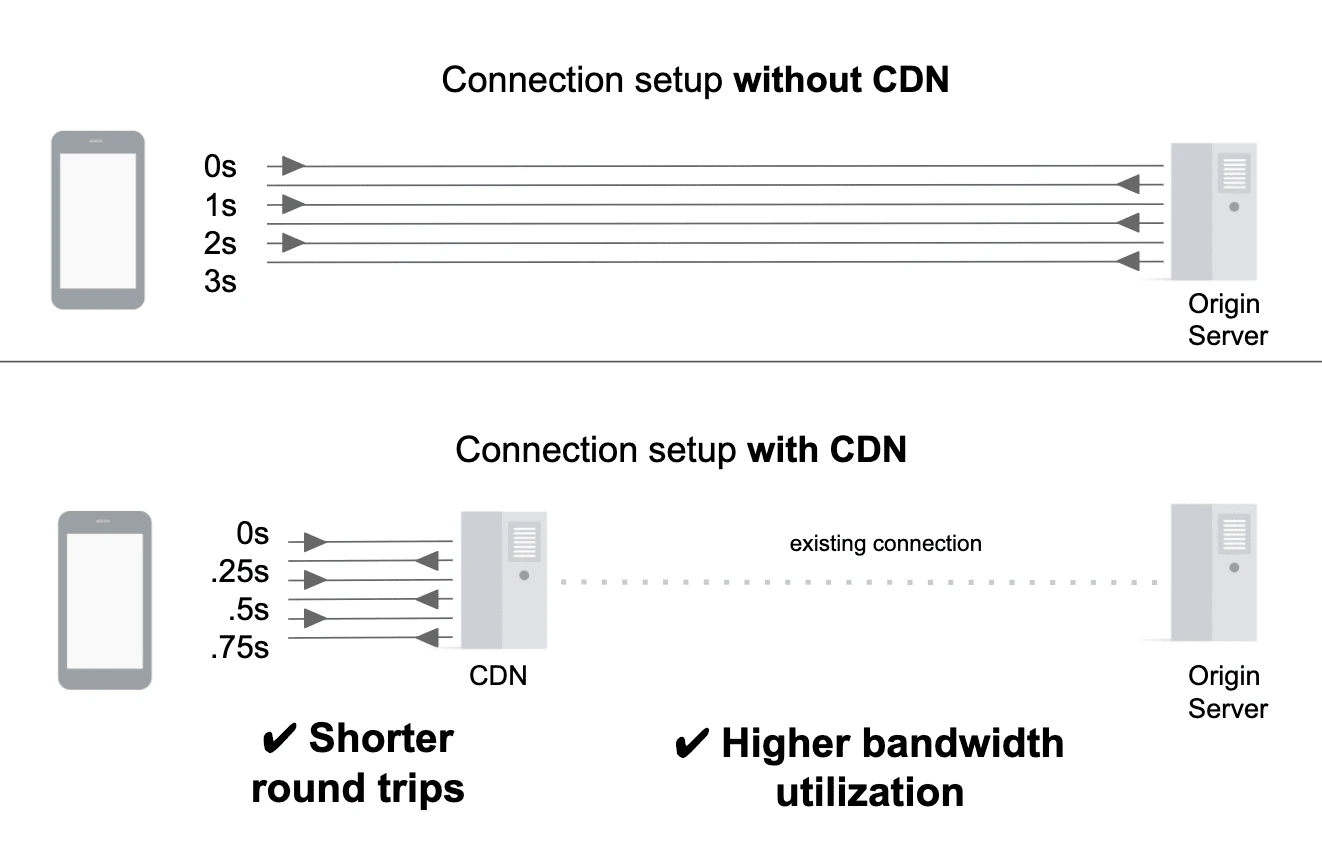
CDNs are widely used for websites, APIs, video-on-demand platforms, and live streaming services. By offloading traffic from the origin server and distributing it across multiple locations, CDNs help organizations scale globally while maintaining consistent performance and availability.

Today, more than half of Internet traffic is diverted by CDNs. As the number of websites targeting the global masses increases, the popularity of CDNs increases and service fees decrease. But there are also free CDN services.
How Does a CDN Work?
A CDN works by distributing content across a network of geographically dispersed servers, often referred to as edge servers. These servers are strategically located close to end users to reduce the physical distance that data must travel.
When a user requests content—such as a web page or video stream—the request is automatically routed to the nearest available edge server. If the content is already cached there, it is delivered immediately. If not, the edge server retrieves it from the origin server, stores a copy, and serves it to the user.
For video streaming, CDNs play a critical role in maintaining performance under high traffic. By serving streams from nearby edge locations, CDNs reduce latency, improve reliability, and prevent overload on the origin infrastructure. This approach enables scalable delivery of both on-demand and live video content to large, distributed audiences.
What are CDN Types?
CDN architectures can be broadly categorized based on the type of content they deliver and the delivery requirements. The most common CDN types used today include general content CDNs, video-on-demand CDNs, and live streaming CDNs.
General Content CDNs are designed to deliver static and dynamic web content such as HTML pages, images, scripts, and APIs. These CDNs focus on fast page load times, efficient caching, and reducing the load on origin servers.
Video-on-Demand (VoD) CDNs are optimized for delivering pre-recorded video content. They work by segmenting videos into small chunks and delivering them using adaptive bitrate streaming. This allows viewers to receive the best possible video quality based on their network conditions and device capabilities.
Live Streaming CDNs are built to handle real-time video delivery at scale. In addition to content distribution, they must support low latency, rapid scaling for concurrent viewers, and high availability during traffic spikes. Live streaming CDNs are commonly used for events, broadcasts, and real-time applications where delays must be minimized.

Recently, HTTP broadcasts often use HTTP servers (Apache or Windows Server). The HTTP broadcast is also compatible with Adaptive Bitrate (ABR). Thanks to the ABR, the videos are split into 2 to 10-second intervals to provide the viewer with optimum speed. Ant Media Server supports ABR by default.
Benefits of Using a CDN
Using a CDN provides multiple performance, reliability, and security benefits for websites and video streaming platforms.
Key benefits of a CDN include:
-
Faster content delivery by serving users from nearby edge servers
-
Reduced latency and improved user experience
-
Lower load on origin servers through efficient caching
-
Better handling of traffic spikes and high concurrency
-
Improved reliability through redundancy and failover
-
Enhanced security against common threats such as DDoS attacks
.
Benefits of Using a CDN for Live Streaming
CDNs play a critical role in live video streaming by enabling scalable, reliable, and low-latency delivery to large audiences. By distributing live streams across geographically dispersed servers, CDNs help maintain performance even during peak traffic.
Scalability:
CDNs allow live streams to scale to thousands or millions of concurrent viewers without overloading the origin server. Traffic is distributed across edge locations, ensuring consistent performance during high-demand events.
Quality:
Viewers access live streams from the nearest available edge server, which reduces buffering and improves playback stability. Adaptive bitrate streaming further ensures that video quality adjusts dynamically based on network conditions.
Reliability:
CDNs improve reliability through redundancy and failover mechanisms. If one edge server becomes unavailable, traffic is automatically routed to another, helping maintain uninterrupted live streaming and mitigating the impact of network or infrastructure failures.
Choosing a CDN Provider
A CDN provider is a service vendor that delivers content to end users through a globally distributed network of servers. While most CDN providers offer similar core functionality, performance and reliability can vary depending on use case, geography, and traffic patterns.
When choosing a CDN provider, organizations should evaluate more than just raw speed. Key factors include geographic coverage, traffic scalability, reliability, security features, and the level of technical support offered.
For video streaming and live broadcasts, it is especially important to consider how the CDN handles high concurrency, traffic spikes, and latency-sensitive workloads. Providers with strong regional coverage, predictable performance under load, and flexible deployment options are better suited for modern streaming applications.
Cost transparency and operational flexibility are also critical considerations. Depending on the use case, organizations may choose a fully managed CDN service, a hybrid approach, or a self-hosted architecture to balance performance, control, and budget requirements.
For example, companies aiming to grow in Europe prefer CDN firms with a large number of POPs located in that region. In addition to the number of POPs, engineering support and urgent deletion/rescue factors should also be considered.
What’s the Live Streaming Latency in a CDN?
Live streaming latency refers to the delay between when a video is captured and when it is viewed by the audience. In CDN-based streaming architectures, latency varies depending on the streaming protocol and delivery method used.
Traditional CDN workflows commonly rely on HTTP-based streaming protocols such as HLS and DASH. These protocols use segmented video delivery and adaptive bitrate streaming, which improves scalability and reliability but typically introduces latency ranging from several seconds to tens of seconds.
As demand for real-time interaction has increased, ultra-low-latency streaming technologies such as WebRTC have become more widely adopted. WebRTC enables sub-second latency by maintaining real-time communication channels, making it suitable for interactive use cases such as live events, online education, auctions, and real-time collaboration.
While traditional CDNs are optimized for HTTP-based streaming, real-time streaming at scale often requires a different architecture. This is commonly achieved by combining CDN delivery for playback formats like HLS or DASH with edge-based or distributed server architectures for WebRTC streaming.
Ant Media Server supports both approaches by enabling scalable delivery of HLS and DASH streams through CDNs, while also supporting real-time streaming through distributed edge nodes for WebRTC-based workflows. This hybrid approach allows platforms to balance scalability, latency, and infrastructure control based on their specific streaming requirements. Please check the documentation if you would like to learn how to scale real-time streaming
Frequently Asked Questions
What is the main purpose of a CDN?
Are CDNs only used for video streaming?
How do CDNs improve live streaming performance?
Can CDNs support low-latency or real-time streaming?
Conclusion
Content Delivery Networks have become a critical part of modern digital infrastructure, enabling fast, reliable, and scalable delivery of web content and video streams across the globe. By distributing content closer to end users, CDNs help reduce latency, improve performance, and support high traffic volumes without overloading origin systems.
For video streaming and live broadcasts, CDNs play an essential role in scalability and reliability, while modern architectures address latency-sensitive use cases through hybrid and edge-based approaches. Choosing the right CDN strategy—based on content type, audience location, and latency requirements—allows organizations to deliver consistent, high-quality experiences today while remaining prepared for future streaming demands.