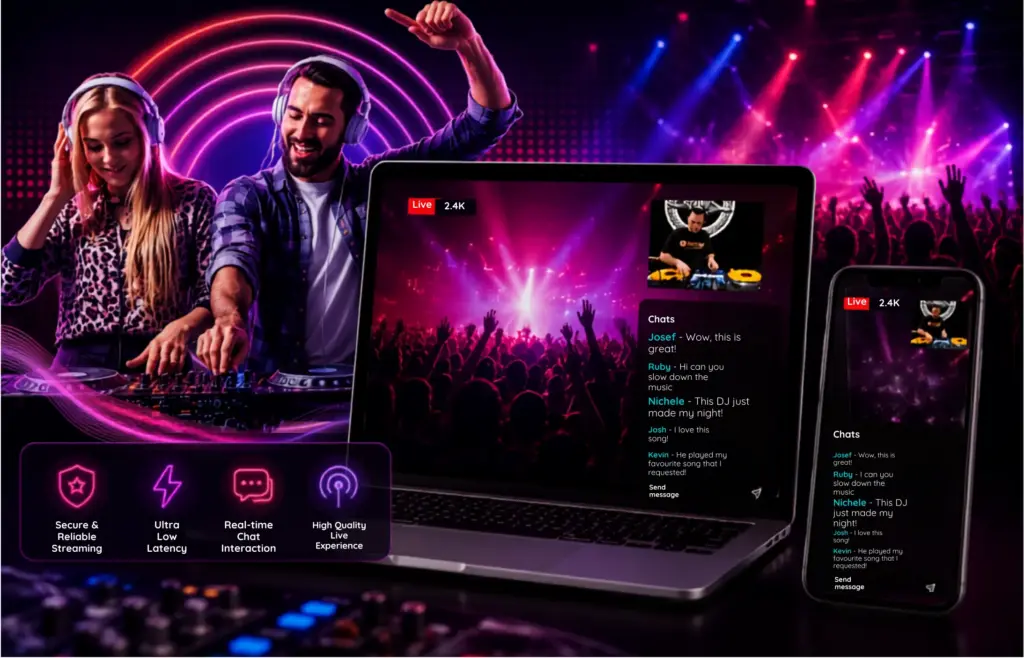

Real-time streaming is essential for live DJ performances. When things go wrong, it’s not just annoying for the audience; it can ruin the entire show. For DJs streaming online, even a little bit of lag can throw off the beat, disconnect the DJ from the crowd, and make venues wary of the tech they’re using. Keeping that connection smooth and seamless is crucial for an unforgettable experience. It is the difference between the listeners saying “That was a sick drop,” and “I could have done that better”
Tadow LLC operates an online DJ streaming platform designed for a specific purpose: streaming DJ performances to venues while also streaming the venue’s live feed back to the DJ (not just audio). This two-way communication requires near-instant synchronization, which most streaming architectures cannot provide. To meet this challenge, Tadow developed a streaming engine specifically built for real-time, low-latency, bidirectional media, rather than using a general-purpose broadcasting tool.
- High streaming latency (10+ seconds)
- Stream stability only 80%
- No reliable bidirectional streaming
- Open-source alternatives couldn’t scale
- Switched to Ant Media Server
- Deployed WebRTC for ultra-low latency
- Enabled two-way DJ-to-venue streaming
- Rapid integration- minimal engineering effort
-
<1sLatency (down from 10+ sec)
-
StabilityStream stability increased from 80%
-
2-WayDJ ↔ Venue streaming enabled
-
SimpleIntegration – fast setup
A Game-Changer for Live Streaming
Before Ant Media Server, Tadow experienced streaming latency of up to 10 seconds, with stream stability at around 80%. For a standard video streaming use case, those numbers might be workable. For a live DJ performance where timing, audience energy, and real-time audio sync are everything- these numbers simply did not work.
The platform’s unique need to stream in both directions added complexity, making it clear that they required a specialized solution. Although the team looked into various open-source streaming servers, none provided the reliability and performance needed for their specific use case. Open-source alternatives were explored, but none delivered the reliability, performance, or simplicity the platform needed at scale.
Why Ant Media Server?
The team chose Ant Media Server for its WebRTC support, which enables sub-second streaming, crucial for real-time interactions. The integration was straightforward, making it easy for the team to focus on building their product rather than managing technical difficulties.
Key factors in the decision:
- WebRTC support enables sub-second, bidirectional streaming
- Significant drop in latency compared to previous open-source solutions
- Straightforward integration process described by the team as “super simple”
- Stream stability improvements that made live sessions reliable enough to build a business on
“Obviously, latency was dropped significantly. Stream stability was great. Integration was super simple.”– Chirag Gupta, Founder and developer.
What Changed?
After implementing Ant Media Server, Tadow saw latency drop dramatically and stream stability soar to near perfection. Now, DJs can perform live sets that feel genuinely connected to the venue, enhancing the overall experience for both DJs and audiences.
The integration itself was described as “super simple,” a significant factor for a lean platform team focused on building a product rather than managing infrastructure.
Looking ahead
Moving forward, Tadow has identified one clear area for development: more options to customize the stream experience, specifically the ability to add watermarks or visual skins to streams. As the platform grows and venues seek branded experiences, these customization features will become increasingly important for differentiation.
With a stable, low-latency streaming foundation now in place, the team is well-positioned to focus on next-layer features that will elevate the product for both DJs and venue partners.
If you’re building an online DJ streaming platform and need scalable, cost-efficient real-time streaming, Ant Media Server’s free trial is a great place to start.