Live streaming has become a core part of how people connect, create, and do business online. Whether you are broadcasting a product launch, running a virtual classroom, or building a telehealth platform, the technology behind every smooth stream is a video streaming protocol. You may have come across terms like RTMP, HLS, WebRTC, SRT, or DASH and wondered what they actually mean and which one you should be using. Choosing the right protocol can make the difference between a stream that runs flawlessly and one that buffers, lags, or breaks entirely. In this guide, we break down the eight most important streaming protocols — what they are, how they work, and which one fits your use case.
Table of Contents
What is a Streaming Protocol?
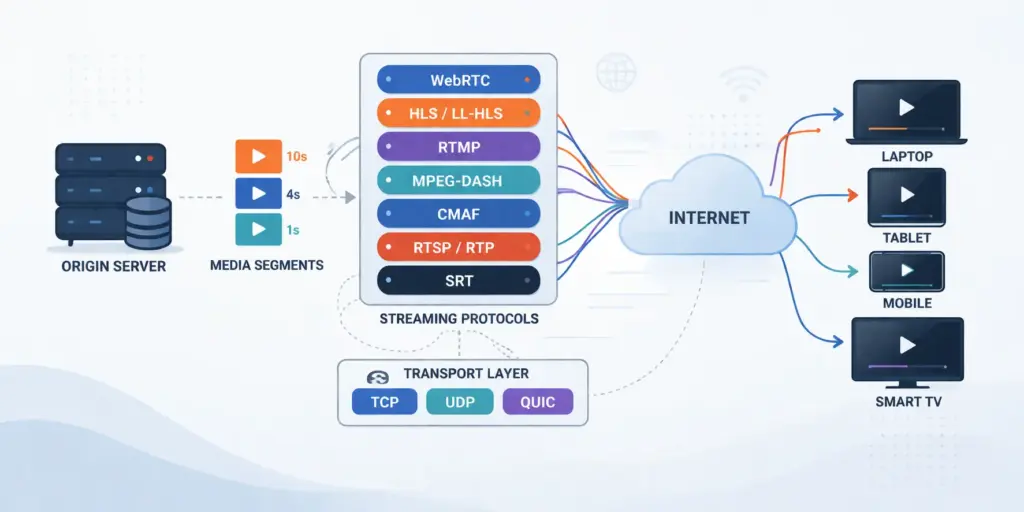
A streaming protocol is a standardized set of rules that governs how video and audio data travels from an origin server to a viewer’s device over a network. Each protocol defines the segmentation method, transport mechanism, error correction behavior, and reassembly sequence that a media server and player must follow to produce uninterrupted playback.
Without a shared protocol, a media server and a client device have no common language for timing, buffering, or error recovery. The protocol resolves this by splitting continuous media into discrete chunks — ranging from 500 milliseconds to 10 seconds in duration depending on the protocol — and specifying how each chunk is labeled, transmitted, and reconstructed at the receiving end.
Streaming protocols operate at the application, presentation, and session layers of the OSI model. They sit above the transport layer protocols — TCP, UDP, or QUIC — that actually move packets across the network.
The eight protocols that matter most to a streaming engineer in 2026 are WebRTC, HLS, LL-HLS, RTMP, MPEG-DASH, CMAF, RTSP/RTP, and SRT. Each was designed to solve a specific delivery problem: latency, scale, reliability, or interoperability.
How Do Streaming Protocols Differ from Codecs and Container Formats?
Streaming protocols, codecs, and container formats are three separate layers of the video delivery stack, and conflating them is one of the most common errors in streaming architecture decisions.
A codec compresses and decompresses raw video frames into a transmittable bitstream. H.264 (AVC), H.265 (HEVC), VP9, and AV1 are codecs — not protocols. A codec determines picture quality per bit, not how those bits travel across a network.
A container format wraps encoded video, audio tracks, subtitles, and metadata into a single file. MP4, MKV, MPEG-TS, and fMP4 (fragmented MP4) are containers. The container defines the file structure, not the delivery mechanism.
A streaming protocol defines the transport rules: how the container is segmented, how segments are requested or pushed, how errors are handled, and how the player synchronizes its buffer to maintain smooth playback.
The practical relationship: H.264-encoded video (codec) packaged in fMP4 (container) can be delivered via HLS, DASH, or CMAF (protocol). Changing the protocol does not change the codec or container — it changes how the encoder, server, and player coordinate data delivery. Architects who treat these as interchangeable make infrastructure decisions that limit their codec upgrade path or lock them into a single CDN architecture.
What are the 3 Transport Layer Foundations: UDP, TCP, and QUIC?
Every video streaming protocol runs on one of three transport layer protocols. The choice between UDP, TCP, and QUIC determines the fundamental trade-off between speed and reliability.
TCP (Transmission Control Protocol) establishes a three-way handshake before transmitting data, guarantees packet delivery and ordering, and retransmits lost packets. This reliability comes at the cost of latency: every retransmission introduces additional round-trip delay. HLS and MPEG-DASH run over TCP via HTTP, which is why they absorb packet loss gracefully but accumulate seconds of latency. Understanding the full TCP vs UDP Streaming explains why protocol latency floors differ by an order of magnitude across the eight protocols covered in this guide.
UDP (User Datagram Protocol) transmits packets without handshakes, ordering guarantees, or retransmission. This produces lower latency at the cost of occasional packet loss. WebRTC and SRT use UDP as their transport base, though SRT adds an ARQ (Automatic Repeat Request) layer on top of UDP to recover selectively from packet loss without the full-reliability overhead of TCP.
QUIC is a modern transport protocol built on UDP with built-in encryption (TLS 1.3), multiplexed streams, and connection migration. QUIC eliminates TCP’s head-of-line blocking by letting independent streams fail independently without stalling others. HTTP/3 — the version of HTTP used by QUIC — enables faster HLS and DASH segment delivery, particularly over mobile networks with variable latency. Ant Media Server supports HTTP/3 delivery paths that reduce segment fetch latency by 15–40% on congested mobile networks compared to HTTP/2 over TCP.
The table below shows how transport layer selection propagates into protocol behavior:
| Transport | Packet Guarantee | Typical Latency | Protocols Using It |
|---|---|---|---|
| TCP | Full ordering + retransmission | 5–30 seconds | HLS, MPEG-DASH, RTMP |
| UDP | None (raw) | 50–500ms | WebRTC (base), RTP |
| UDP + ARQ | Selective retransmission | 120ms–4 seconds | SRT, WebRTC (with NACK) |
| QUIC (UDP-based) | Stream-level independence | 2–8 seconds | HTTP/3-based HLS/DASH |
The four protocols in the table above cover the full latency spectrum from sub-500ms real-time communication to broadcast-quality 30-second VOD delivery.
What are the 8 Most Important Video Streaming Protocols in 2026?
The eight protocols below divide into three functional categories: real-time protocols (sub-1-second latency), HTTP-adaptive protocols (2–30 seconds, scale-optimized), and contribution protocols (encoder-to-server ingest). Understanding which category a protocol belongs to is the prerequisite for correct architectural decisions.
What is WebRTC and When Should It Be Used?

WebRTC (Web Real-Time Communications) is a browser-native protocol standardized by the W3C and IETF (RFC 8825 series) that delivers bidirectional audio and video at sub-500ms glass-to-glass latency. WebRTC establishes peer connections using ICE candidate negotiation over STUN and TURN infrastructure, with DTLS-SRTP encryption mandatory on every media path per RFC 8826.
WebRTC transmits media using RTP over UDP, with RTCP managing packet loss reporting, jitter estimation, and bandwidth adaptation. The adaptive jitter buffering mechanism in WebRTC adjusts dynamically to network fluctuations, maintaining playback continuity at latencies that no HTTP-based protocol can match.
Technical specifications:
| Attribute | Value |
|---|---|
| Latency | ~0.5 seconds (sub-500ms glass-to-glass) |
| Video codecs | H.264, VP8 (H.265 via mobile SDK only; not standard browser WebRTC) |
| Audio codecs | Opus, G.711, G.722 |
| Transport | UDP via RTP/RTCP |
| Security | DTLS-SRTP (mandatory) |
| Scalability | Requires SFU or MCU for >10 concurrent participants |
| Browser support | Chrome, Firefox, Safari, Edge (all major browsers) |
Where WebRTC delivers unique value: interactive streaming applications where viewer-to-presenter latency below 1 second is non-negotiable — live auctions with bid confirmation, telehealth consultations, sports betting with live event feeds, real-time gaming, and one-to-many broadcasts where sub-second delivery prevents spoiler propagation from social media.
Scaling WebRTC beyond peer-to-peer constraints requires WebRTC SFU scaling infrastructure that selectively forwards media streams without full decoding and re-encoding at the forwarding node. Ant Media Server’s SFU architecture maintains sub-500ms latency to each subscriber while routing origin publisher media through a centralized forwarding plane — enabling 10,000+ concurrent WebRTC viewers from a single ingest source. The WHIP (WebRTC HTTP Ingest Protocol) support in Ant Media Server version 2.10.0+ enables OBS-to-WebRTC ingest without RTMP, removing the last major friction point in all-WebRTC streaming pipelines.
What is HLS and How Does It Work?
HLS (HTTP Live Streaming) is an adaptive bitrate streaming protocol developed by Apple in 2009, published as RFC 8216, and now the most widely deployed streaming format across all device categories. HLS segments video into discrete .ts (MPEG-TS) or fMP4 chunks, delivers a master M3U8 playlist with multiple bitrate renditions, and lets each player independently select the rendition that matches available bandwidth.
The HLS adaptive bitrate ladder enables the same stream to serve a viewer on a 500Kbps mobile connection and a viewer on a 50Mbps fiber connection from the same origin infrastructure. Each rendition in the ladder represents a distinct resolution and bitrate combination — typically 6–8 renditions spanning 240p at 300Kbps to 4K at 15Mbps — selected automatically by the HLS player based on download throughput measurement. The player evaluates download speed for each segment and switches renditions at segment boundaries without interrupting playback.
Technical specifications:
| Attribute | Value |
|---|---|
| Latency | 8–12 seconds (standard); 2–5 seconds (LL-HLS) |
| Video codecs | H.264, H.265 (HEVC) |
| Audio codecs | AAC-LC, HE-AAC v1 & v2, xHE-AAC, Apple Lossless, FLAC |
| Transport | TCP via HTTP/1.1, HTTP/2, HTTP/3 |
| DRM support | FairPlay, Widevine, PlayReady via HLS encryption (AES-128) |
| Scalability | Unlimited (CDN-native) |
| Playback compatibility | Chrome, Safari, Firefox, Edge; iOS, Android; all smart TVs |
HLS’s most critical architectural advantage is CDN nativity: standard web CDN infrastructure caches HLS segments without custom configuration, enabling cost-effective delivery to millions of simultaneous viewers. Netflix, YouTube, and Twitch all use HLS or HLS-derived formats for their primary delivery paths.
The primary constraint of standard HLS is latency accumulation: a 6-second segment duration with 3-segment buffer requirement produces a theoretical minimum latency of 18 seconds before accounting for encoding, packaging, and CDN propagation delays. For broadcast content where live-to-linear synchronization matters, this latency is acceptable. For interactive content, it is not.
What is Low-Latency HLS (LL-HLS) and How Does It Reduce Latency?
LL-HLS (Low-Latency HLS) is an Apple-specified extension to the HLS standard, introduced in iOS 14 and macOS Big Sur, that achieves 2–5 second latency by replacing full-segment delivery with partial segments and blocking playlist requests.
LL-HLS introduces three mechanisms that standard HLS lacks. First, partial segments of 200–300ms duration replace the full 6-second segments, reducing the minimum latency to the partial segment duration plus one round-trip. Second, HTTP/2 server push delivers upcoming segments before the player requests them. Third, blocking playlist requests prevent the player from polling on an interval — the server holds the request open and responds the instant a new segment is available.
Technical specifications:
| Attribute | Value |
|---|---|
| Latency | 2–5 seconds |
| Backward compatibility | Falls back to standard HLS on non-LL-HLS players |
| Partial segment duration | 200–300ms |
| Segment duration | 1–2 seconds (reduced from 6-second standard) |
| CDN compatibility | Requires CDN with HTTP/2 server push support |
| Codec support | Inherits full HLS codec support |
LL-HLS partial segment delivery replaces the full-segment download model of standard HLS with 200–300ms partial segments delivered via blocking playlist requests, eliminating the segment accumulation latency that makes standard HLS unsuitable for sports second-screening and interactive live events. Ant Media Server generates LL-HLS output via a paid plugin (available from version 2.11+, Enterprise Edition only), enabling a single publishing workflow to produce both standard HLS (for CDN distribution) and LL-HLS (for low-latency delivery) from the same encoding pipeline.
What is RTMP and Why is it Still Used in 2026?
RTMP (Real-Time Messaging Protocol) is a TCP-based protocol originally developed by Macromedia (acquired by Adobe in 2005) for streaming audio and video between a Flash Player and a dedicated streaming server. Flash was officially deprecated in 2020, but RTMP survived because it became the universal standard for encoder-to-server video contribution.
OBS Studio, vMix, Wirecast, and virtually every hardware encoder on the market output RTMP by default. The RTMP ingest path — encoder → RTMP → media server → HLS/WebRTC/DASH delivery — remains the most widely deployed live streaming architecture in 2026. Wowza’s 2021 Video Streaming Latency Report found that over 76% of content distributors used RTMP for ingest.
Technical specifications:
| Attribute | Value |
|---|---|
| Latency | 5 seconds |
| Video codecs | H.264, VP8, VP6 (H.265 via Enhanced RTMP from AMS v2.11+) |
| Audio codecs | AAC, AAC-LC, HE-AAC v1 & v2, MP3, Speex |
| Transport | TCP |
| Playback compatibility | Extremely limited (not supported on iOS, Android, or modern browsers) |
| Variants | RTMPS (TLS), RTMPE (Adobe encryption), RTMPT (HTTP tunneling), RTMFP (UDP) |
RTMP’s role in 2026 is ingest, not delivery. No major streaming platform accepts RTMP for viewer-facing delivery — iOS, Android, and all modern browsers reject it. Its value is the massive installed base of RTMP-capable encoders and the mature tooling ecosystem around it. RTMP ingest configuration from OBS, vMix, or any hardware encoder requires three parameters: the RTMP server URL, the stream key, and the encoder video codec selection (H.264 for maximum RTMP compatibility). Ant Media Server accepts RTMP ingest from any RTMP-compatible encoder and transcodes it to WebRTC, HLS, LL-HLS, DASH, and CMAF for delivery — allowing operators to preserve their encoder infrastructure while migrating to modern delivery protocols.
RTMPS — RTMP over TLS — is the minimum security standard for RTMP ingest paths that traverse public internet routes. Platforms that accept unencrypted RTMP ingest are transmitting stream keys and media in plaintext.
What is MPEG-DASH and How Does it Differ from HLS?
MPEG-DASH (Dynamic Adaptive Streaming over HTTP) is an international standard (ISO/IEC 23009-1) published in 2012 by the Moving Picture Experts Group. MPEG-DASH is codec-agnostic and vendor-independent, distinguishing it from HLS’s Apple-controlled specification.
MPEG-DASH delivers an XML-based Media Presentation Description (MPD) manifest instead of HLS’s M3U8 playlist. The MPD describes available bitrate representations, segment durations, and codec parameters. The DASH manifest packaging generates an XML MPD file that describes each bitrate representation as an AdaptationSet containing Period, Representation, SegmentTemplate, and SegmentTimeline elements — providing the player with the segment URL template, codec parameters, and initialization segment location for each quality level. The player selects representations and fetches segments via standard HTTP requests, identical in mechanism to HLS.
Technical specifications:
| Attribute | Value |
|---|---|
| Latency | 8–12 seconds (standard); 2–5 seconds (LL-DASH with CMAF) |
| Video codecs | Codec-agnostic (H.264, H.265, VP9, AV1 all supported) |
| Audio codecs | Codec-agnostic |
| Transport | TCP via HTTP |
| DRM support | CENC (Common Encryption) with Widevine, PlayReady |
| Scalability | Unlimited (CDN-native) |
| Playback compatibility | Chrome, Firefox, Edge, Android; limited iOS/Safari support |
The critical gap between HLS and MPEG-DASH: iOS and Safari do not support MPEG-DASH natively. Applications targeting iOS audiences must either use HLS or implement a JavaScript DASH player (dash.js) and accept the additional client-side complexity. For cross-platform delivery targeting both iOS and non-iOS audiences, a dual-packaging pipeline — HLS for Apple devices, DASH for everything else — is the standard architecture.
What is CMAF and Why Does It Matter?
CMAF (Common Media Application Format) is a container and packaging standard developed by Apple and Microsoft (ISO 23000-19) that resolves the HLS-vs-DASH dual-packaging problem. CMAF defines a single fMP4-based segment format that both HLS and MPEG-DASH players can consume, eliminating the requirement to store two separate sets of encoded segments on origin storage.
Before CMAF, a broadcaster targeting both iOS (HLS) and non-iOS (DASH) audiences had to encode, package, and store segments in two distinct formats: MPEG-TS for HLS and MP4 for DASH. CMAF replaces both with a single fMP4 segment stream that HLS and DASH manifests can both reference.
Technical specifications:
| Attribute | Value |
|---|---|
| Latency | 3–5 seconds (standard CMAF); 1–2 seconds (Low-Latency CMAF with chunked transfer) |
| Segment format | Fragmented MP4 (fMP4) / ISOBMFF |
| Codec support | H.264, H.265, VP9, AV1 |
| DRM | CENC with single-key multi-DRM (Widevine + FairPlay + PlayReady from one key) |
| Delivery compatibility | Works with both HLS and MPEG-DASH manifests |
CMAF chunked transfer encoding pushes fMP4 chunk data to HTTP clients before the full segment completes writing, using HTTP/1.1 Transfer-Encoding: chunked headers to stream chunk boundaries in real time — reducing CMAF delivery latency to 1–2 seconds from the same CDN edge nodes that serve standard CMAF without requiring edge-side code changes. Ant Media Server packages CMAF output natively, enabling operators to deliver a single encoded stream to HLS players on iOS and DASH players on Android and smart TVs from a single origin packaging process — reducing origin storage costs by up to 50% compared to dual-format pipelines.
What is RTSP and Where is It Still Used?

RTSP (Real-Time Streaming Protocol) is a presentation-layer protocol defined in RFC 2326 that controls multimedia server sessions using pause, play, and seek commands. RTSP itself does not transport media — it establishes and controls sessions while RTP (Real-Time Transport Protocol) carries the actual media payload.
RTSP functions as a “network remote control” for media servers. The RTSP/RTP stack is the native output protocol for the vast majority of IP cameras, CCTV systems, and professional PTZ cameras. This ubiquity in surveillance and broadcast production infrastructure is why RTSP remains relevant despite its lack of browser support.
Technical specifications:
| Attribute | Value |
|---|---|
| Latency | 2 seconds |
| Video codecs | H.265, H.264, VP9, VP8 |
| Audio codecs | AAC, AAC-LC, HE-AAC v1 & v2, MP3, Speex, Opus, Vorbis |
| Transport | RTP over UDP (default); TCP interleaving available |
| Playback compatibility | VLC, QuickTime, 3GPP-compatible mobile players; not supported in browsers |
| Primary use case | IP camera ingest, CCTV monitoring, studio production feeds |
RTSP stream ingest from IP cameras follows a three-step sequence: DESCRIBE (client requests session description), SETUP (client specifies transport parameters), and PLAY (server begins RTP media transmission). Ant Media Server’s RTSP pull mechanism initiates this sequence to any RTSP/RTCP-compliant camera, converting the received RTP payload to WebRTC delivery — enabling any ONVIF or RTSP-compatible IP camera to deliver its feed to web browsers without requiring browser-side RTSP support. This RTSP-to-WebRTC conversion path is the standard architecture for web-accessible surveillance and remote monitoring systems.
What is SRT and Why is it Replacing RTMP for Contribution?

SRT (Secure Reliable Transport) is an open-source protocol developed by Haivision, released to the SRT Alliance in 2017, and designed specifically for low-latency video transmission over unpredictable public internet connections. SRT operates over UDP with an ARQ-based retransmission layer that selectively recovers lost packets without the full-stream retransmission penalty of TCP.
The SRT ARQ retransmission mechanism distinguishes SRT from raw UDP streaming by detecting packet loss via sequence number gaps, requesting retransmission of only the lost packets, and reassembling the stream in order before presenting it to the decoder — producing reliable delivery at latencies 2–4x lower than RTMP over congested public internet paths. SRT’s configurable latency buffer (120ms to 4 seconds) allows operators to tune the retransmission window to match the round-trip time and packet loss rate of their specific contribution network.
Technical specifications:
| Attribute | Value |
|---|---|
| Latency | 120ms–4 seconds (configurable latency buffer) |
| Video codecs | Codec-agnostic (transports any codec as payload) |
| Audio codecs | Codec-agnostic |
| Transport | UDP with ARQ retransmission |
| Security | AES-128 and AES-256 encryption (built-in) |
| Packet loss recovery | Up to 25% packet loss with full stream recovery (at 1-second latency buffer) |
| Playback compatibility | Encoder-to-server contribution only; not for browser playback |
SRT is replacing RTMP as the primary contribution protocol for professional broadcast, remote production, and sports streaming workflows. The 2020 virtual NFL Draft used SRT as its primary contribution protocol to manage the unpredictable home internet connections of remote participants — demonstrating SRT’s production-grade reliability at a major broadcast event.
Ant Media Server accepts SRT ingest and delivers the received stream via WebRTC, HLS, LL-HLS, or DASH. The SRT-to-WebRTC path enables contribution from any SRT-capable encoder (OBS 28+, vMix, Haivision encoders) with viewer-facing delivery at sub-500ms latency — a combination that standard RTMP-to-HLS pipelines cannot achieve.
How Do Streaming Protocols Compare Across Latency, Scalability, and Security?
The eight protocols above address different problems. Selecting the wrong protocol for a use case produces latency that ruins interactivity, scale ceilings that break under load, or security gaps that expose stream keys. The table below maps each protocol across the five dimensions that drive architectural decisions:
| Protocol | Latency | Scalability | Security | Ingest | Delivery |
|---|---|---|---|---|---|
| WebRTC | Sub-500ms | Medium (SFU required) | DTLS-SRTP (mandatory) | Yes (WHIP) | Yes |
| HLS | 8–12 seconds | Unlimited (CDN) | AES-128, DRM | No | Yes |
| LL-HLS | 2–5 seconds | High (CDN) | AES-128, DRM | No | Yes |
| RTMP | 5 seconds | Low | TLS (RTMPS only) | Yes | No |
| MPEG-DASH | 8–12 seconds | Unlimited (CDN) | CENC multi-DRM | No | Yes |
| CMAF | 1–5 seconds | Unlimited (CDN) | CENC multi-DRM | No | Yes |
| RTSP/RTP | 2 seconds | Low | None (standard) | Yes (cameras) | No |
| SRT | 120ms–4 seconds | Medium | AES-256 (built-in) | Yes | No |
Three architectural patterns emerge from this comparison. First, ingest and delivery are separate problems: RTMP, SRT, and RTSP are contribution protocols; HLS, DASH, CMAF, and WebRTC are delivery protocols. Second, low latency and high scalability are mutually exclusive for a single protocol — WebRTC achieves sub-500ms but requires SFU infrastructure for scale; HLS scales infinitely but accumulates latency. Third, security is not uniform: RTSP has no encryption by default, RTMP requires explicit RTMPS configuration, and WebRTC encrypts every media packet by specification.
The WebRTC vs RTMP latency comparison quantifies a 10x latency difference between the two protocols: RTMP delivers at 5 seconds due to TCP’s acknowledgment cycle and streaming server buffering, while WebRTC delivers at sub-500ms through UDP-based RTP with ICE-negotiated direct paths. For use cases where this latency difference determines whether a viewer experience is interactive or passive — live auctions, sports betting, and interactive webinars — the protocol choice is the primary architectural decision.
How Do You Choose the Right Streaming Protocol for Your Use Case?
Protocol selection starts with two binary questions: Does the use case require viewer interaction below 1 second? And does the use case require delivery to more than 10,000 concurrent viewers?
For sub-1-second interactive streaming: WebRTC is the only protocol with sub-500ms latency. Live auctions, telehealth consultations, real-time bidding, interactive gaming, and financial trading feeds all require WebRTC delivery. SRT provides sub-2-second latency for contribution paths where the encoder has SRT support.
For high-scale broadcast (10,000+ concurrent viewers): HLS or LL-HLS with CDN delivery is the correct architecture. LL-HLS achieves 2–5 second latency with unlimited CDN scale. Standard HLS achieves 8–12 second latency with the same unlimited scale and the broadest device compatibility of any protocol.
For enterprise DRM and content protection: CMAF with CENC encryption supports Widevine, FairPlay, and PlayReady from a single encryption key — the most cost-efficient multi-DRM architecture available. MPEG-DASH with CENC is the alternative for non-Apple audiences.
For IP camera and surveillance integration: RTSP is the universal IP camera protocol. The correct architecture is RTSP ingest at the server, with WebRTC or HLS delivery to browser-based monitoring dashboards. IP camera WebRTC delivery from Ant Media Server converts the RTSP output of any ONVIF-compliant camera into a browser-accessible WebRTC stream — the server performs the protocol translation between RTSP/RTP and WebRTC/DTLS-SRTP, delivering the camera feed to Chrome, Firefox, or Safari at sub-500ms latency through a standard HTTPS web page.
For encoder-to-server contribution from remote locations: SRT is the 2026 standard for professional contribution over public internet paths. RTMP remains acceptable for stable broadband connections with no packet loss risk.
The table below maps the most common streaming use cases to their recommended protocol stack:
| Use Case | Ingest Protocol | Delivery Protocol | Latency Target |
|---|---|---|---|
| Live auction / bidding | RTMP or WHIP | WebRTC | Sub-500ms |
| Sports streaming | SRT | LL-HLS or WebRTC | 1–3 seconds |
| Telehealth / telemedicine | WHIP (WebRTC) | WebRTC | Sub-500ms |
| E-learning / webinar | RTMP or SRT | LL-HLS | 2–5 seconds |
| VOD / catch-up TV | N/A | HLS or DASH + CMAF | N/A |
| IP camera monitoring | RTSP | WebRTC | Sub-500ms |
| Linear broadcast / OTT | RTMP or SRT | HLS + CMAF | 6–30 seconds |
| Social media simulcast | RTMP | RTMP (platform) | Platform-controlled |
The use-case-to-protocol mapping in the table above clarifies that no single protocol handles all requirements. Production streaming architectures use 2–3 protocols simultaneously: a contribution protocol for ingest, a real-time delivery protocol for interactive viewers, and an HTTP-adaptive protocol for scale delivery to passive viewers.
Validating protocol latency figures in a controlled test environment before committing to a production architecture prevents the most costly streaming infrastructure mistakes. Operators who need to test WebRTC delivery latency against LL-HLS and DASH on the same ingest source can configure Ant Media Server’s multi-protocol output pipeline — accepting a single RTMP or SRT ingest and simultaneously producing WebRTC, LL-HLS, and CMAF delivery paths — within a self-hosted 14-day free trial instance that runs on any Linux server or cloud VM without a credit card requirement.
What is the WHIP Protocol and Why Does It Matter in 2026?
WHIP (WebRTC HTTP Ingest Protocol) is an IETF standard (RFC 9725, published March 2025) that defines a standardized HTTP-based signaling mechanism for publishing WebRTC streams to media servers. Its playback counterpart, WHEP (WebRTC HTTP Egress Protocol), standardizes WebRTC stream consumption from servers to players using the same HTTP-based model. WHIP eliminates the proprietary signaling implementations that previously prevented interoperability between WebRTC encoders and media servers.
Before WHIP, WebRTC publishing required a custom WebSocket signaling protocol for each media server vendor — OBS could not directly publish WebRTC to a server without vendor-specific plugins. WHIP standardizes the offer/answer exchange over a single HTTP POST, enabling any WHIP-compatible encoder to publish to any WHIP-compatible server without additional configuration.
OBS Studio added WHIP support in version 30.0. FFmpeg merged a WHIP muxer into its codebase following version 6.1, with full distribution in later releases. Any streaming workflow that previously required an RTMP hop from encoder to server can now use native WebRTC via WHIP, eliminating the 5-second RTMP latency from the ingest path.
Ant Media Server (Enterprise Edition) implements the WHIP ingest endpoint on the same infrastructure as standard WebRTC publishing — accepting HTTP POST requests containing SDP offers from OBS 30+, FFmpeg, and any WHIP-compatible encoder, then establishing the WebRTC session at sub-500ms glass-to-glass latency without RTMP in the pipeline. WHIP-to-WebRTC delivery achieves the lowest possible end-to-end latency in a production streaming system — encoder to viewer in under 500ms total.
Production streaming architectures that combine SRT contribution with WebRTC delivery achieve the lowest end-to-end latency available from a hardware encoder. Operators building this architecture for live auction, sports wagering, or telehealth platforms can validate SRT-to-WebRTC pipeline performance under load through Ant Media Server’s 14-day free trial, which enables full SRT ingest, WebRTC SFU delivery, LL-HLS fallback output, and horizontal auto-scaling configuration — the complete production protocol stack — without time-limited feature gating or enterprise plan requirements.
Frequently Asked Questions
What is the lowest-latency streaming protocol available in 2026?
WebRTC delivers the lowest achievable latency at ~0.5 seconds glass-to-glass. No HTTP-based protocol — including LL-HLS and Low-Latency CMAF — achieves sub-1-second delivery. WebRTC accomplishes this through UDP-based RTP transport and ICE-negotiated direct peer connections, bypassing the segment accumulation delay inherent in all HTTP-adaptive protocols.
What streaming protocol does YouTube use?
YouTube uses DASH (Dynamic Adaptive Streaming over HTTP) for on-demand content and HLS for live streams. Both protocols are served from Google’s CDN infrastructure. YouTube’s RTMP ingest path accepts RTMP from encoders and transcodes to DASH/HLS for viewer delivery. YouTube added LL-HLS support for live streams in 2023.
Is RTMP still relevant in 2026?
RTMP remains the dominant encoder-to-server contribution protocol in 2026 due to universal support across OBS, vMix, Wirecast, and hardware encoders. However, SRT and WHIP are replacing RTMP for professional contribution workflows where packet loss recovery and lower latency matter. RTMP is not used for viewer-facing delivery — HLS, WebRTC, and DASH handle all delivery.
What is the difference between HLS and MPEG-DASH?
HLS is an Apple-specified proprietary standard that uses M3U8 manifests and MPEG-TS or fMP4 segments, with native support on all Apple devices. MPEG-DASH is an ISO international standard that uses XML MPD manifests and MP4 segments, with no native iOS or Safari support. Both achieve equivalent scalability and latency at the CDN delivery layer. The decisive factor for most architectures is iOS support — HLS is the only protocol with native iOS video playback.
What streaming protocol is best for IP cameras?
RTSP is the native protocol for IP cameras. Virtually all ONVIF-compliant IP cameras output RTSP/RTP streams. For browser-accessible delivery, the correct architecture is server-side RTSP ingest with WebRTC re-publication — the server converts the RTSP stream to WebRTC for sub-500ms delivery to browser-based monitoring dashboards.
What is the difference between SRT and RTMP for live streaming contribution?
SRT handles packet loss through UDP-based ARQ retransmission, recovering from up to 25% packet loss at a 1-second latency buffer. RTMP uses TCP, which recovers from packet loss through full-stream TCP retransmission — producing latency spikes and jitter on congested networks. SRT also includes built-in AES-256 encryption, while RTMP requires explicit RTMPS configuration for encryption. For professional contribution over public internet paths, SRT is the 2026 standard.
Can a streaming server support multiple protocols simultaneously?
Ant Media Server accepts ingest via WebRTC (WHIP), RTMP, RTMPS, SRT, and RTSP simultaneously and delivers each ingested stream via WebRTC, HLS, LL-HLS, MPEG-DASH, and CMAF from the same origin encoding pipeline. A single RTMP ingest from OBS simultaneously produces WebRTC output at sub-500ms latency and HLS output for CDN-scale delivery to passive viewers — without requiring separate encoding or server infrastructure for each delivery protocol.
What streaming protocol should I use for a telehealth application?
WebRTC is the only protocol appropriate for telehealth applications requiring bidirectional video at sub-500ms latency. DTLS-SRTP encryption is mandatory in WebRTC by specification, satisfying the encryption requirements of HIPAA-adjacent technical safeguards. LL-HLS is not appropriate for telehealth because it is unidirectional and accumulates 2–5 seconds of latency — clinically significant for real-time assessment interactions.
Conclusion
Eight protocols govern professional video streaming in 2026: WebRTC for sub-500ms interactive delivery, HLS for unlimited-scale broadcast, LL-HLS for low-latency broadcast, RTMP for encoder ingest, MPEG-DASH for multi-DRM non-Apple delivery, CMAF for single-origin dual-format packaging, RTSP for IP camera integration, and SRT for packet-loss-resilient contribution. No single protocol handles all use cases — production architectures combine 2–3 protocols across the ingest, processing, and delivery layers.
The operational infrastructure that converts between these protocols — accepting RTMP or SRT ingest and producing WebRTC, HLS, LL-HLS, and DASH delivery simultaneously from one encoding pipeline — is where Ant Media Server operates. Operators building this multi-protocol stack can validate SRT-to-WebRTC pipeline performance through Ant Media Server’s 14-day free trial, with full access to SRT ingest, WebRTC SFU delivery, LL-HLS output, and auto-scaling configuration from day one.