
Real-Time Messaging Protocol (RTMP) is a communication protocol for streaming audio, video, and data over the Internet. Originally developed as a proprietary protocol by Macromedia for streaming between Flash Player and the Flash Communication Server, Adobe (which acquired Macromedia) has released an incomplete version of the specification of the protocol for public use.
In this guide we will talk about what the legendary streaming protocol RTMP is about, what are the alternatives and how to get a free RTMP server in 7 steps.
Watch how to install an RTMP server
What is RTMP?
RTMP is a TCP-based protocol initially developed by Macromedia (later acquired by Adobe) to deliver audio, video, and data between a server and Flash player. Even though Flash is now obsolete, RTMP continues to be widely used as a live stream ingest protocol, especially in broadcasting workflows.
RTMP’s strength lies in its ability to deliver low-latency, persistent streaming over TCP connections, making it ideal for first-mile delivery from encoders like OBS, vMix, or mobile apps to media servers. Once the stream reaches the server, it can be transcoded or transmuxed into more playback-friendly formats such as HLS, WebRTC, or CMAF.
Today, RTMP remains a crucial part of the streaming stack because of:
- Stable, real-time data transmission
- Support across open-source encoders
- Easy integration with most media servers
Whether you’re building a professional-grade streaming platform or just trying to push a live stream to your audience, understanding RTMP is the foundation.
What is a streaming protocol?
A streaming protocol is a set of rules that defines how audio or video data is transmitted from one device to another over a network, typically the internet. It ensures that media can be delivered smoothly and in the correct order so it can be played back in real time or near real time.
Instead of sending an entire media file at once, streaming protocols break the content into small pieces and deliver them continuously. This allows playback to begin almost immediately and adapt to network conditions, reducing buffering and interruptions.
For streaming to work, both the sender and the receiving device must support the same protocol. Common streaming protocols include HLS, MPEG-DASH, RTMP, SRT, RTSP, and WebRTC, each designed for different use cases such as live streaming, on-demand video, or low-latency communication.
What is an RTMP server?

Real-Time Messaging Protocol or RTMP, is a communication protocol for live audio and video streaming over the internet. It was developed as a TCP protocol by Macromedia to stream between a Flash Player and a server. Macromedia was later acquired by Adobe and the once proprietary protocol is now an open specification.
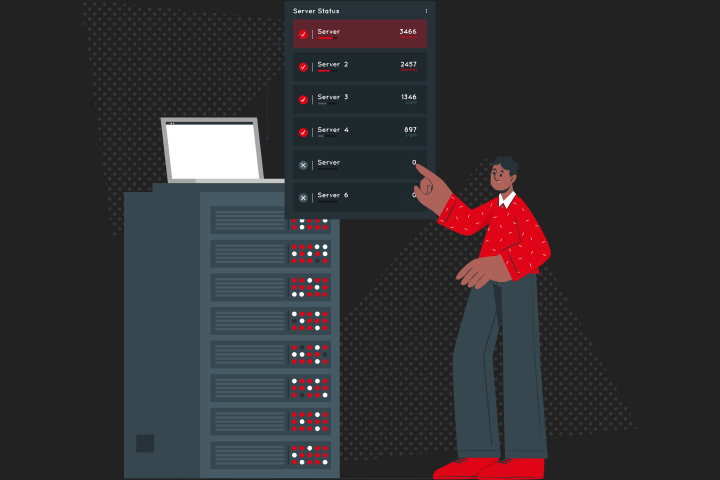
So, what is an RTMP server? An RTMP server allows you to take an incoming Real-Time Messaging Protocol (RTMP) live video stream from an encoder and transmux it into a playback protocol like WebRTC, HLS, DASH & LL-HLS for viewing.
RTMP today is known for its low-latency video streaming capabilities. To maintain persistent connections during a live stream, the RTMP splits your stream into smaller fragments.
The sizes of these fragments can vary dynamically depending on the connection between the source and the server. Sometimes these fragments can also be the same size. The default fragment size is 128 bytes for video data. These smaller chunks of data are easier to transmit over the internet.
RTMP streaming protocol features
- Audio Codecs: AAC, AAC-LC, HE-AAC+ v1 & v2, MP3, Speex
- Video Codecs: H.264, HEVC (H265), VP8, VP6, Sorenson Spark®, Screen Video v1 & v2
- Playback Compatibility: Not widely supported anymore
- Limited to Flash Player, Adobe AIR, and RTMP-compatible players
- No longer accepted by iOS, Android, most browsers, and most embeddable players
- Benefits: Low latency and minimal buffering
- Drawbacks: Not optimized for quality of experience or scalability
- Latency: 5 seconds
RTMP variations:
- RTMP: The plain TCP-based protocol
- RTMPS: Uses a secure SSL connection to minimize the risk of cloud-based streaming.
- RTMPE: Uses Adobe’s proprietary security encryption and is a lighter-weight encryption layer than RTMPS.
- RTMPT: Encapsulated with HTTP to bypass firewalls and corporate traffic filtering.
- RTMFP: Uses UDP instead of TCP
Benefits of an RTMP server
Let’s take a closer look at the benefits of the RTMP server.
Low latency
The biggest benefit of streaming through the RTMP server is the low latency it offers. The latency in RTMP is not more than 5 seconds and maybe even lower. That means from the moment a video is captured at your end, it does not take more than 5 seconds to stream on the viewer’s screen.
Minimal buffering
RTMP minimizes buffering at the viewers’ end, which means less annoyance for them. Hence, your audience sticks to your live stream for longer.
Adaptive Bitrate Streaming (ABR)
RTMP can compress the data and change the video quality to match the user’s bandwidth, so they continue to receive a continuous stream. This is known as Adaptive Bitrate Streaming. This way, your viewers can enjoy uninterrupted streaming even with low bandwidth.
RTMP alternatives
Although RTMP was once a popular solution for live streaming, Adobe discontinued Flash Player in 2017, which ended RTMP’s role as a last-mile playback protocol. Despite this, RTMP is still commonly used today as a first-mile ingest protocol, delivering live streams from encoders to streaming servers.
For ingest, modern alternatives to RTMP have emerged—most notably SRT (Secure Reliable Transport), which offers improved reliability, security, and performance over unpredictable networks.
For playback, RTMP has been fully replaced by HTML5-compatible streaming technologies such as WebRTC (for ultra-low latency), HLS, LL-HLS and MPEG-DASH, which provide scalable, adaptive streaming across web browsers, mobile devices, and smart TVs.
HLS (HTTP Live Streaming)

HLS stands for HTTP Live Streaming. It is an adaptive, HTTP-based streaming protocol used to deliver video and audio content from media servers to end-user devices.
HLS was developed by Apple in 2009 and announced around the same time as the launch of the iPhone 3. Earlier iPhone models experienced challenges with live streaming playback, and Apple introduced HLS to address these issues by enabling more reliable and scalable video delivery over standard HTTP networks.
Low-Latency HLS (LL-HLS)
We’re thrilled to announce that starting from v2.11, Ant Media Server now supports low-latency HLS (LL-HLS), a cutting-edge technology that is revolutionizing video streaming. With this new capability, you can serve HLS streams with minimal latency, providing your audience with lightning-fast, real-time video playback like never before. Check out this blog for LL-HLS with Ant Media Server.
CMAF (Common Media Application Format)

Common Media Application Format (CMAF) is basically a new format to simplify the delivery of HTTP-based streaming media. It is an emerging standard to help reduce cost, complexity and provide latency around 3-5 seconds in streaming.
CMAF helps us with single-approach encoding, packaging, and storage. CMAF is one of the best alternatives to RTMP streaming protocol for low latency streaming.
WebRTC (Web Real-Time Communication)
WebRTC is another streaming protocol and abbreviation for Web Real-Time Communications. This open-source protocol helps real-time communication between browsers and mobile applications. This protocol is known for its extremely low latency, which is less than 500 milliseconds.
Where to get a free RTMP server for live streaming?

If you are looking for a free RTMP server, try Ant Media. The Ant Media server supports various protocols, including RTMP, RTSP, WebRTC, HLS, CMAF, SRT, and more. The platform provides adaptive and ultra-low-latency streaming through WebRTC technology. The latency is around 0.5 seconds, which is a great option for interactive video and communication.
Ant Media offers the Community Edition for free and an Enterprise Edition, where you can get direct support and be covered by SLAs. This highly scalable solution can run on-premise or on the cloud, whichever is convenient for you.
Why choose the Ant Media Server?

Ant Media Server is one of the fastest-growing and most popular streaming engines. Ant Media Server supports WebRTC, CMAF, HLS, RTMP, RTSP, and more for your critical business streaming needs.
Streaming through Ant Media server gives you benefits like:
- Adaptive Bitrate Streaming
- Highly scalable, real-time streaming to millions of viewers and publishers
- Free live streaming software development kits for iOS, Android, JavaScript, Flutter, and Unity
- Live video monitoring and surveillance using IP cameras
Ant Media Community Edition for a free RTMP Server
The biggest benefit you enjoy with Ant Media is our Community Edition license. It is a free RTMP streaming software. With the Community Edition, you can install RTMP Server easily and you can have an RTMP server free.
Ant Media Server Community Edition is a free, self-hosted, and self-managed streaming software where you get:
- Low latency of 8 to 12 seconds
- RTMP and WebRTC ingestion
- RTSP, RTMP, and HLS pulling
- Live playback with HLS and MP4
- Live recording with MP4
- VoD and IP Camera capabilities
- Community support
If you are just starting out with live streaming and looking for a free RTMP server, the Ant Media Community Edition License could be the perfect solution for you. Moreover, it is an open-source RTMP Server.
Join our growing community and download Ant Media Server Community Edition
Who needs the Ant Media Enterprise Edition license?
The Enterprise Edition License is also open-source and a paid solution on cloud hosting solutions or on-prem.
You can try Ant Media Server Enterprise with our 14-day free trial; thereafter, there are three different upfront-based plans, starting from $109 per month per instance.
With the base plan on our Enterprise Edition License, you get:
- Ultra-low end-to-end latency of 0.5 seconds
- Scalability with cluster support
- Adaptive Bitrate Streaming
- Hardware encoding
- RTMP, WebRTC, SRT and WHIP ingestion
- Playing with WebRTC, RTMP, HLS, LL-HLS & DASH
- Free WebRTC SDKs for Android and iOS
- Direct support from Ant Media
If you are a student or a university, you could get our Enterprise Edition License for free. Get in touch with us to know more. Also, Ant Media has a special startup program. If you meet the application conditions, apply now.
You can check the community and enterprise edition comparison table here.
Go and select an Ant Media Enterprise License
How to install and deploy a free RTMP server in 7 steps
It takes only 7 steps to have an RTMP server free.
1. Download Ant Media Server
Download and save the Ant Media Server Community/Enterprise Edition to your server.
- Community Edition Zip file can be downloaded from here directly
- Enterprise Edition can be downloaded on your account after you get a license on antmedia.io
2. Open Terminal and go to the directory
Open a terminal and go to any directory like /home/ubuntu which is default for many instances.
cd /home/ubuntu3. Download the installation script
Download the installation script to install AMS.
wget https://raw.githubusercontent.com/ant-media/Scripts/master/install_ant-media-server.sh && chmod 755 install_ant-media-server.sh4. Run the installation script
Install the Enterprise Edition
Add your license key as a parameter, which you received via email, to the installation file using the -l parameter, and then execute it. If you have a valid license key, the installation process will begin.
sudo ./install_ant-media-server.sh -l 'your-license-key'Install the Community Edition
You can simply run the script without any parameters to automatically download and install the latest version of the Community Edition.
sudo ./install_ant-media-server.sh5. Control the Service
After installation, you can check the service if it is running.
sudo service antmedia statusYou can stop/start the service anytime you want.
sudo service antmedia stop
sudo service antmedia start
6. Install SSL for your Ant Media Server
Please make sure that your server instance has a public IP address and a domain is assigned to its public IP address. Then go to the folder where Ant Media Server is installed. Default directory is/usr/local/antmedia.
cd /usr/local/antmediaRun the enable SSL script in the AMS installation directory. Don’t forget to replace {DOMAIN_NAME} with your domain name.
sudo ./enable_ssl.sh -d {DOMAIN_NAME}For detailed information about SSL, follow the SSL Setup guide here.
7. Accessing the web panel
Open your browser and type http://SERVER_IP_ADDRESS:5080 to go to the web panel. If you’re having difficulty accessing the web panel, there may be a firewall that blocks accessing the 5080 port.
That’s all. You now have a free RTMP server if you use the community edition.
To publish an RTMP stream to Ant Media Server, check out the RTMP publishing document.
Conclusion
In this article, we explained RTMP, RTMP servers, other protocols, and how you can set up a free RTMP server. In other words, a free live streaming server.
Hopefully, you now have a good understanding of what an RTMP server is, how to use a free RTMP server, how it can support your live streams, and what the current alternatives are.
You can use this server to stream using broadcasting tools such as OBS, XSplit, and Vmix and as an RTMP test server. If you want to use a free RTMP server on Windows using WSL, you can check out this guide.
Live streaming is here to stay. Be it games, video conferences, webinars, e-learning, entertainment streaming platforms, online bidding, or some other area, the demand for live streams is only going to increase in the coming years.
FAQs
Is RTMP free to use with Ant Media Server?
What are the main RTMP alternatives?
How do I choose between RTMP and HLS for my use case?
Can I secure my RTMP streams?
Does Ant Media support RTMP variations like RTMPS or RTMPT?
Start a free trial of Ant Media Enterprise, an ultra-low latency WebRTC live streaming engine
Estimate Your Streaming Costs
Use our free Cost Calculator to find out how much you can save with Ant Media Server based on your usage.
Open Cost Calculator